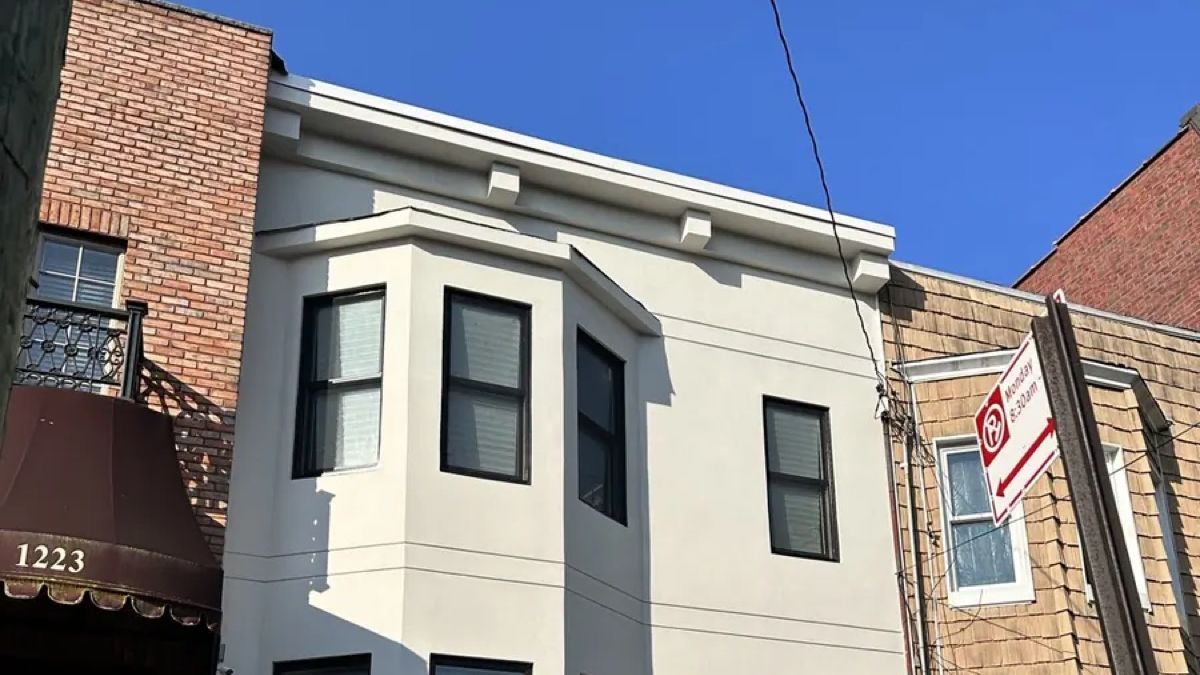
The Cornice Is the First Thing That Fails
On a Brooklyn row house the cornice is the band of molding that caps the facade right where the wall meets the roof. It is the detail that gives the block its character, and it is also the part of the building that takes the most water, because every drop that comes off the roof edge passes over it or behind it.
That is why it is almost always the first thing to go. We get called to a cracked cornice far more often than to a cracked wall. By the time a piece lands on the sidewalk the problem has usually been running for years behind the face, where nobody could see it.
Why Brooklyn Cornices Come Apart
The cause is almost never the stucco itself. It is water arriving from above and then having nowhere to go.
- A failed roof edge. The roof membrane stops short, the drip edge is missing or rusted through, and water runs down the back of the cornice instead of off the front of it.
- A clogged rear gutter. Water backs up, finds the joint between the roof and the cornice and soaks the assembly from inside.
- An original wood cornice underneath. Plenty of Brooklyn row houses have a wood box cornice that was stuccoed over at some point. The wood rots, the stucco loses its backing and the face cracks in a straight horizontal line.
- Sheet metal rusting from behind. Pressed tin cornices from the 1890s and 1900s rust from the inside out. The face can look solid while the back is paper.
- Freeze and thaw. Once water is inside, every winter widens the crack. A hairline in November is an open joint by March.
If pieces are falling, call first and read later. A spalling cornice over a public sidewalk is a safety issue before it is a repair job. Call (516) 713-9199 and we will get out to look at it, usually the same day.
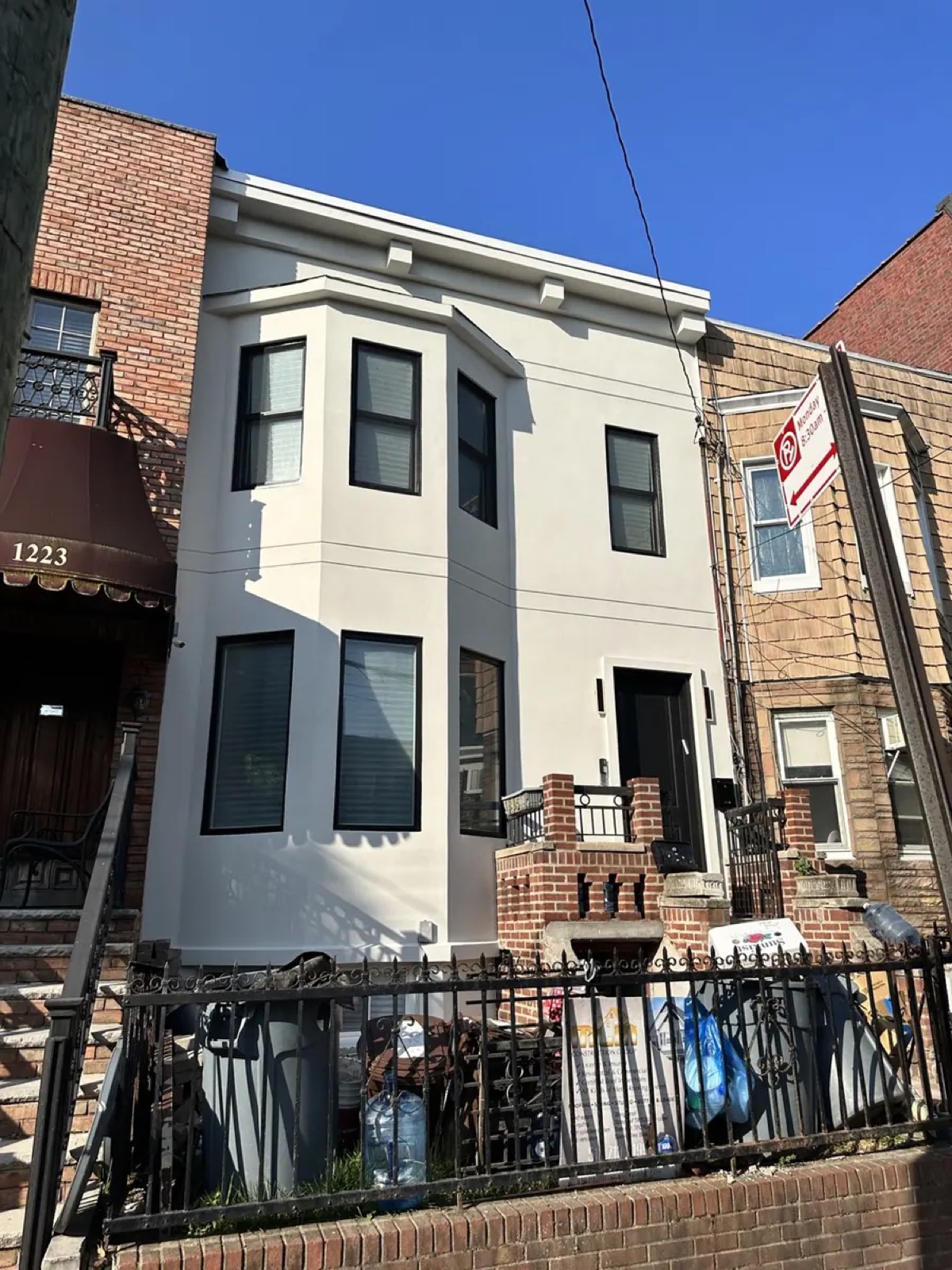
Repair or Rebuild
We do not sell a full rebuild when a repair will hold. At the estimate we sound the whole run with a hammer to find where the stucco has separated from its backing, then we decide based on how much of it is still bonded.
Repair, when 70 percent or more is sound
We cut back to solid material, rebuild the damaged section in the same profile, mesh the joint so it does not telegraph through, and refinish the entire run so the patch does not read as a patch. This is the usual outcome on a cornice that has one bad corner or one failed section over a downspout.
Full rebuild, when the backing is gone
If the wood box behind the stucco has rotted or the metal has rusted through, patching the face only buys a season. We take the old cornice off, correct the roof termination so water stops arriving, and build a new cornice in lightweight EPS with mesh and hard coat. The new assembly weighs a fraction of what came off, which matters on a 120 year old parapet.
What We Build
Crown Cornice
The full cap at the top of the facade, including the bed molding, the fascia and the crown. The piece that defines the roofline of the block.
Dentils & Modillions
The repeating blocks and brackets under the crown. Cut to the original spacing so the rhythm matches the houses on either side.
Band & Belt Courses
The horizontal lines that run across the facade between floors. The cheapest detail per foot and the one that changes a flat wall the most.
Window Headers & Sills
Headers, sills and side casings. On most row houses the window trim is cut from the same profile family as the cornice above it.
Keystones & Quoins
Keystones over openings and corner quoins down the edge of the facade. Stock profiles or custom cut to a template.
Parapet Caps
The coping that sits on top of the parapet wall. Done right it sheds water away from the cornice instead of into it.
Everything we build uses the same assembly: an expanded polystyrene core cut to the profile, a fiberglass reinforcing mesh embedded in a base coat so it does not crack, and a hard finish coat on top. It looks like cast stone from the sidewalk, weighs about a tenth as much, and does not rot or rust. See the full range on our foam architectural moldings page.
How the Job Runs
Photos, then a free on site look
Text us a shot from the sidewalk and, if you can get up there, one from the roof. That is usually enough for us to tell you whether you are looking at a repair or a rebuild before anyone drives out. The on site estimate is free and written out by scope.
Profile template
We take a template off the sound part of your own cornice. If the whole run is gone we template the neighboring house, which on most Brooklyn blocks was built by the same hand in the same year.
Fix the water first
No cornice work starts until the roof edge above it is sorted out. Drip edge, termination, gutter. Skipping this step is the single most common reason a repaired cornice fails again.
Build, mesh, coat
Core cut and set, mesh and base coat, then the finish. Three to five days on a typical row house run of 18 to 26 feet, longer if the weather will not let the coat cure.
Walkthrough and warranty
We walk the finished run with you before the final payment, and you get a written 20-year workmanship warranty.
What It Costs
Simple band and belt course profiles run about $8 to $15 per linear foot installed. A full ornate cornice assembly with modillion blocks or dentils runs about $40 to $80 per linear foot. Keystones and one off decorative pieces are priced individually.
Access moves the number as much as the profile does. A cornice we can reach from a roof scaffold costs well under one that needs a sidewalk shed and a permit on a busy street. We tell you which one you are looking at at the estimate, not after. Our full stucco price breakdown covers the rest of the exterior.
Permits, FISP and Landmarks
Like for like cornice repair on a low rise row house is normally ordinary repair and does not need a DOB permit. Two things change that.
- Buildings over six stories fall under Local Law 11 and the Facade Inspection Safety Program, so cornice work is part of a filed cycle and needs a QEWI.
- Landmark districts. Park Slope, Brooklyn Heights, Crown Heights North, Bed Stuy and a long list of others require Landmarks approval before any visible change to the facade, including the cornice profile and the finish color.
We tell you which bucket your building is in at the estimate, before you spend anything. More on this in our guide to stucco permits in NYC.
Where We Work
Cornice work across Brooklyn, with the heaviest concentration in the row house neighborhoods: Park Slope, Bedford Stuyvesant, Crown Heights, Sunset Park, Bay Ridge, Greenpoint and Williamsburg. We also cover Queens and Nassau County. See the full list on our Brooklyn stucco page.