Snow shoveled against a stucco wall holds the base of that wall wet for weeks and carries road salt into it. MNM Construction Stucco has repaired salt and freeze damage on Brooklyn and NYC walls since 2009. Free inspection at (516) 713-9199.
A Snow Pile Is a Three Week Soak
Rain against a wall is over in hours and the wall starts drying immediately. A snow bank is different. It sits there, it melts slowly from the bottom up against the warmest surface it is touching, which is your heated wall, and it refreezes every night. On a shaded Brooklyn side alley a pile shoveled in early January can still be there at the end of the month.
So the bottom two or three feet of that wall spends weeks wet. It never gets a chance to dry, and every single night it goes through a freeze thaw cycle while saturated. That is the single most destructive thing that can happen to stucco, and it happens in the exact band of the wall that was already the most vulnerable.
And the Snow Is Not Clean
Snow shoveled off a NYC sidewalk or driveway is not just water. It carries whatever was on that surface, and in winter that is road salt and the calcium chloride the city and your neighbors spread. When that pile melts against the wall, the salt goes into the stucco with the water.
Salt does two things. It draws moisture out of the air and holds it, so a salted wall stays damper for longer than a clean one. And as the water evaporates the salt crystallizes inside the pores of the stucco and expands, which breaks the material apart from the inside. That is the chalky white bloom and the crumbling, sandy surface you see at the bottom of so many walls by March.
It also reaches the metal. Corner bead and lath are steel, and salt accelerates corrosion badly. Rusting steel expands and pushes the stucco off from behind, which is why a wall that got a salted snow pile against it for a few winters often fails along the whole bottom corner rather than in one spot.
Where to Put It Instead
The rule is simple: throw it away from the house, not against it. On most Brooklyn and Queens lots that means toward the street side of the sidewalk, toward the center of the driveway, or onto the lawn away from the foundation, rather than into the gap between the house and the fence.
If you only have one place to put it, keep a gap. Two or three feet of clear ground between the pile and the wall is enough that the melt runs into the soil instead of down the face of the stucco, and it lets the wall dry between storms.
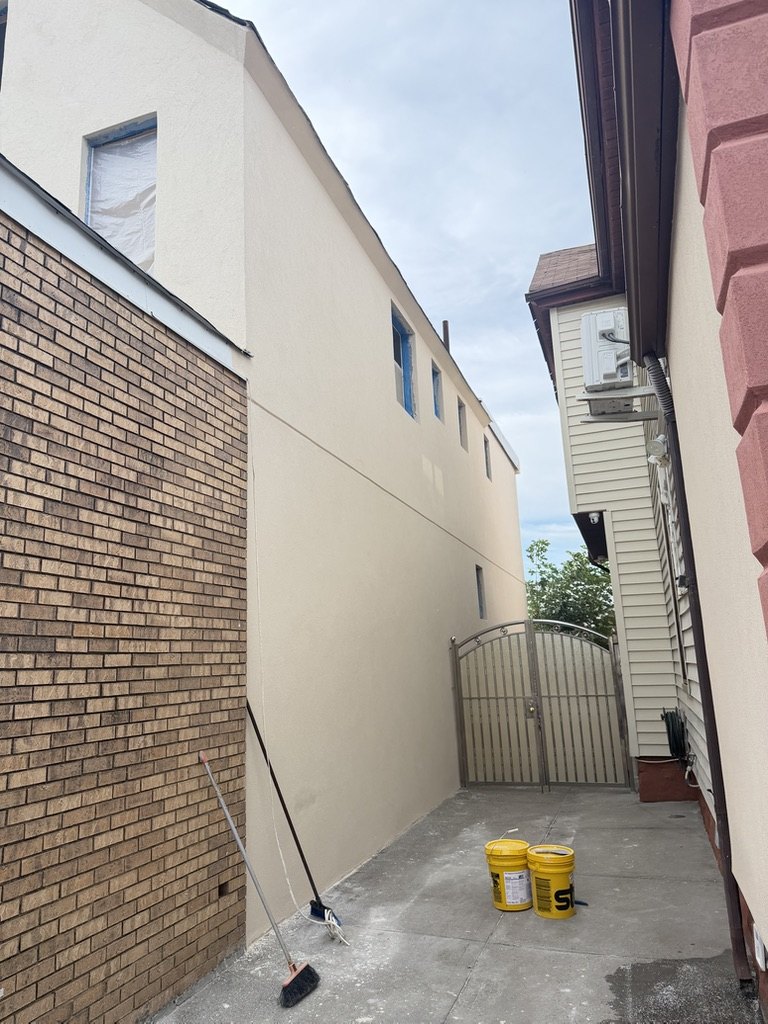
Pay attention to the narrow side alley specifically. It is the most common place people pile snow in this city because it is out of the way, it is the shadiest spot on the property so the pile lasts longest, and it is usually the elevation nobody looks at until there is a problem inside.
Do Not Put Rock Salt Against the Wall Either
The same logic applies to the salt you spread yourself. Salt applied on a path right up against the house ends up in the splash zone at the base of the wall every time it rains or melts. Keep the spreading a foot or so off the wall where you can, and use sand on the strip closest to the house if you need traction there.
What the Damage Looks Like When You Find It in Spring
It starts as a band along the bottom of the wall, usually between the ground and about two feet up, which is exactly where the pile sat. The paint blisters or flakes. The surface goes chalky and comes off on your hand as a fine sand. Tap it and it sounds hollow.
Then the face starts coming off in flakes, and eventually in sheets. Once the face is off, the material behind it is exposed directly to the next winter, and the rate of damage accelerates, because the protective finish coat was doing most of the work.
If there is also rust bleeding through, the metal inside has gone and the repair gets bigger. That is the difference between a repair done in the spring after one bad winter and a repair done after three.
The Five Minute Check Before the First Snow
Walk the perimeter of the house now and look at the bottom two feet of every wall. You are looking for three things.
Open cracks low on the wall, because those will take meltwater straight into the wall for weeks. A chalky or sandy surface, which means last winter already did damage and this winter will go faster. And soil, mulch or a garden bed built up so the stucco disappears into the ground, which means the wall is wicking moisture out of the soil continuously and a snow pile on top of that is worse again.
Any one of those is worth closing up before the ground freezes. MNM Construction Stucco works across Brooklyn, Queens, the Bronx, Manhattan, Nassau and Suffolk, and the inspection and written estimate cost nothing. Call (516) 713-9199 or (917) 570-7311.